Bike Rack, Roof Box, Rear Box: What They Do to Your Axle Load
Reading time: about 7 minutes
Most build plans end at the rear door. Yet many vans carry a lot behind it or on top: a bike rack with two e-bikes, a rear box, a roof box, a rooftop tent, a spare wheel. These kilograms don’t just count towards the payload – they also act quite differently from the same weight inside.
We worked it out with VanLogic in a Fiat Ducato L3H2 (wheelbase 4035 mm).
The basics of axle load: How to calculate campervan axle load. What a build weighs in total: How much does a van conversion weigh?
The lever behind the rear axle
Think of the van as a plank on two trestles – the axles. Whatever lies between the trestles is shared by both. Whatever lies behind the rear trestle pushes it down harder and lifts the front one.
You can work it out yourself:
- Extra on the rear axle = weight × (wheelbase + distance behind the rear axle) ÷ wheelbase
- Less on the front axle = weight × distance behind the rear axle ÷ wheelbase
50 kg in four places
The same 50 kg test weight, placed four different ways – calculated by VanLogic in the Ducato L3H2:
| Where the 50 kg sit | Front axle | Rear axle |
|---|---|---|
| Middle of the load area | +14.4 kg | +35.6 kg |
| Right above the rear axle | ±0 kg | +50.0 kg |
| Rear outside, 30 cm behind the rear door | −12.3 kg | +62.3 kg |
| Roof, centre | +14.4 kg | +35.6 kg (centre of gravity 35 mm higher) |
Behind the rear door, the rear axle carries 62 kg – for a 50 kg load. And the front axle gets lighter. With front-wheel drive, as in the Ducato, that weight is missing on the driven wheels; you notice it when pulling away on wet grass or gravel.
Example: rear carrier with two bikes
Click for the full-size original
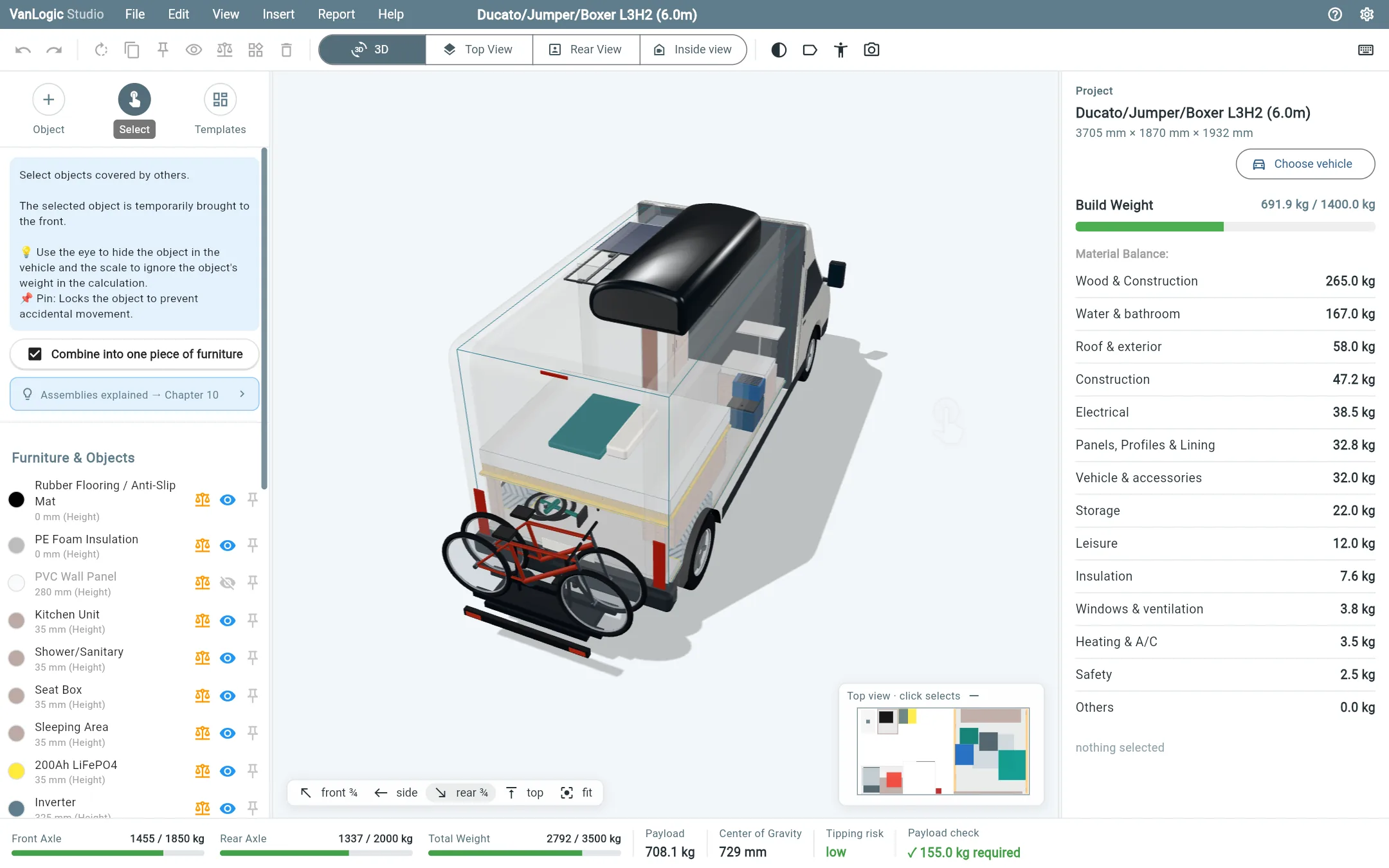
The Outdoor & Adventure build template comes with a tow-bar bike carrier and two bikes: carrier 16.4 kg, bikes 14 kg each – 44.4 kg in total. VanLogic calculates:
- Rear axle: +57.6 kg
- Front axle: −13.2 kg
With two e-mountain bikes (25 kg each in the catalogue), it would be 66.4 kg on the carrier – by the same calculation about 86 kg more on the rear axle and about 20 kg less at the front. The tow bar itself adds another 32 kg.
That’s what the Rear outside zone in VanLogic is for: under Rests on: you put a carrier, rear box or spare wheel behind the rear door, and the Distance behind the rear door slider sets how far. The axle loads update immediately.
Nose weight: what the tow bar carries
A tow-bar carrier hangs on the ball. Carrier plus bikes must therefore not exceed the nose weight (tongue weight). It is stated in the vehicle documents and on the tow bar’s rating plate – the lower of the two values applies.
Tow-bar carriers for two bikes usually weigh between 13 and 21 kg, and many are rated for a 60 kg load. So work it out: nose weight − carrier weight = what the bikes may weigh. With two heavy e-bikes it gets tight quickly.
On the roof: roof load and centre of gravity
On the roof the lever on the axles is smaller – centred, the weight spreads like a load inside. Instead, two other limits apply:
- Roof load: how much may go on the roof is in the owner’s manual. Roof rack and box count towards it: roof load − roof rack − box = what can still go in.
- Centre of gravity: every kilogram up there raises it. 50 kg on the roof raise the centre of gravity by 35 mm in the Ducato example. VanLogic shows the Tipping risk in the weight bar.
For comparison, the catalogue weights in VanLogic: Roof Rack 35 kg, Roof box approx. 500 l 23 kg, Rooftop tent, hard shell 72 kg – each empty.
Carriers in VanLogic
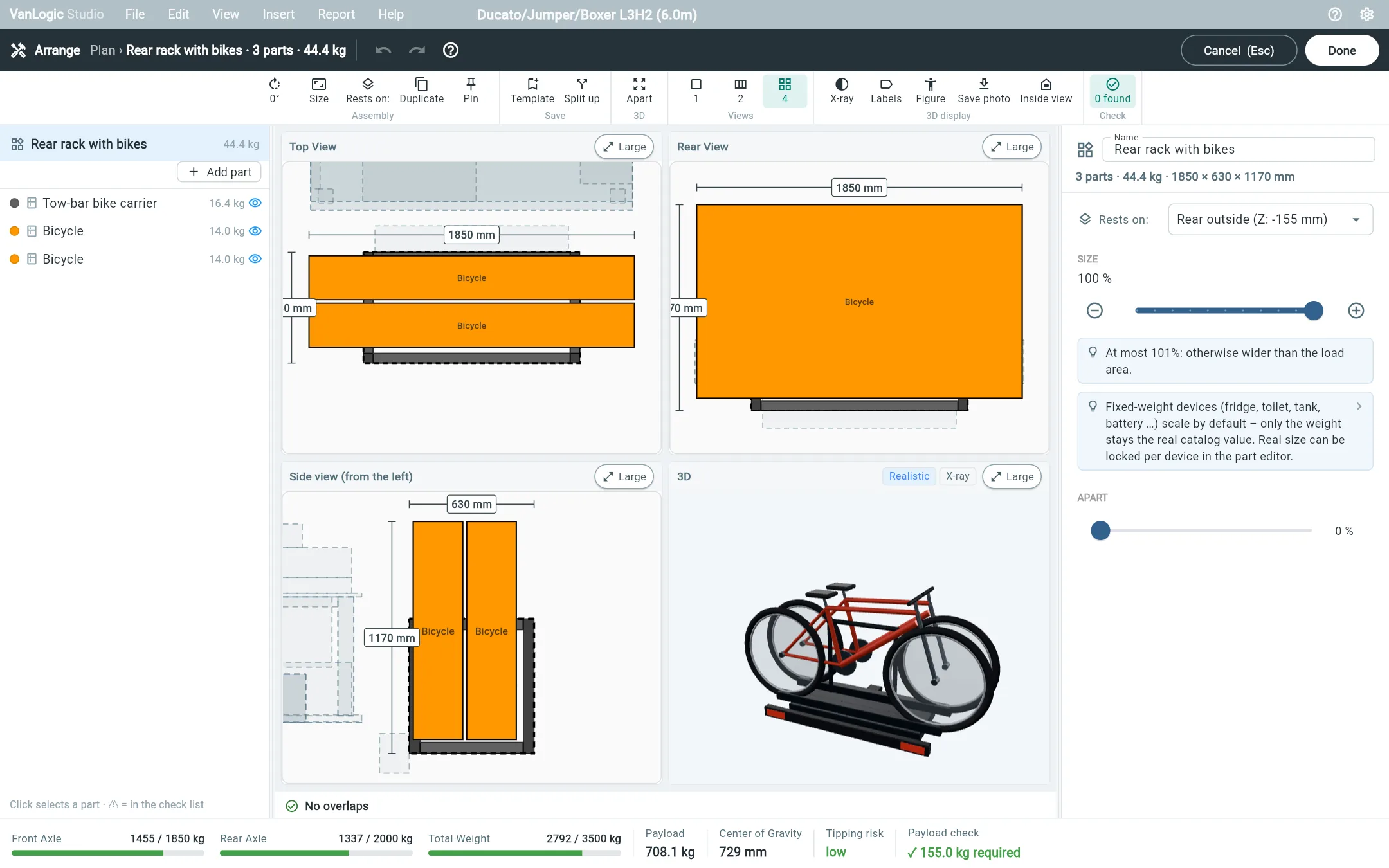
In VanLogic you put on a carrier what really sits there. Whatever stands on or in a carrier does not count as an overlap:
- bikes in a bike rack (on the rear door or on the tow bar)
- a roof box, rooftop tent, solar panel or surfboard on the roof rack or crossbars
- a rear box on the cargo platform
- the rear carrier on the tow bar
- spare wheel and jerry can in their holders
If something reaches into the carrier from below, the app still warns. In 3D, bikes are always drawn along their long side – whether they hang on the carrier at the back or stand crosswise inside.
Click for the full-size original
Checklist before you drive
- Put everything in the plan that hangs outside: carriers, bikes, boxes, spare wheel – with their real weight.
- Check the rear axle, not just the total weight. The lever quickly turns 50 kg into 60.
- Nose weight against carrier + bikes.
- Roof load against roof rack + box + contents.
- Tipping risk when a lot goes on the roof.
Many carriers and roof components (tow-bar bike carrier, roof rack, roof box) and the collision details are Pro features. In the app’s Test Mode and in the browser (30 minutes per plan), everything is free.
Frequently Asked Questions
Why does a bike rack load the rear axle more than it weighs?
The rear axle acts as the pivot of a lever. Whatever hangs behind it pushes it down harder and lifts the front axle. In a Ducato L3H2, 50 kg hanging 30 cm behind the rear door put 62.3 kg on the rear axle – and the front axle gets 12.3 kg lighter.
How much can a tow-bar bike carrier hold?
Carrier and bikes together must not exceed the nose weight (tongue weight). It is stated in the vehicle documents and on the tow bar's rating plate – the lower value applies. On top of that, every carrier has its own maximum load, 60 kg for many tow-bar carriers.
Do the roof box and bike rack count towards the payload?
Yes. Everything attached to or lying on the vehicle counts towards the payload and the total weight – carrier, box and contents. On the roof, the permitted roof load applies too, and the roof rack and box count towards it.
Is a roof box better for the axle load than a rear carrier?
For how the weight is shared between the axles, yes: centred on the roof, it spreads like a load inside. But the centre of gravity rises – 50 kg on the roof lift it by 35 mm in the Ducato example. Hanging at the back, the centre of gravity stays low, but the rear axle carries more.